Hand Hold
‘Pressed’ glass, 2024
Hand Hold celebrates community. The work explores touch and connection between people, and our connections to objects that allow us to relate across generations and cultures.
Hand Hold references the grips we make to steady ourselves to traverse a tricky terrain, and the hands we reach out to one another to help us cross. The pocket-sized glass medallions were created with the Glass Pavilion hot shop team during a February 2024 GAPP residency. These glass objects contain points of reference and inspiration to the TMA collections, its Libbey Glass founders, and greater Toledo. They are made to be collected by viewers.
Scroll down to read more about the project. Links to additional information are indicated like this.
This story is, at its core, a love story – to community and humanity and the ethereal, fragile strands that connect us all together. And of course, the story revolves around glass – the inspirational material tying together all the threads: inspiration, beauty and extraordinary objects, community, accessibility, and resources.
Click the link to watch a short video of Misha Nalepa using a graphite stamp to create the “Hand Hold” glass medallions.
The idea of creating a small object to share with others came from the delight I still feel from a gift I received from an artist in Cadiz, KY that I often carry in my pocket: a small cast glass heart she made from Stephen Rolfe Powell murrini. This talisman is smooth, shiny, beautiful, and connects me to a Kentucky glass heritage and wider arts community. In a time and place that can feel challenging for artists and all who might think differently, I appreciate its grounding properties.
Providing the TMA and Glass Pavilion visitors with a gift was also inspired by Beth Lipman’s site specific sculptural installation ReGift, now on view in the TMA, created during a 2022 GAPP residency.
Through this transcendental work, Lipman presents the TMA community with her own unique gift that honors the museum's collection and its founders. She emphasizes the importance of remembering their original contribution and, in this act of celebration, effectively re-gifts the museum and its collection to the Toledo community once more.
The method for creating the Hand Hold talisman is intrinsically related to the process and democratizing ethos of the glass press and pressed glass, popularized by Libbey Glass.
Working in collaboration with Protostamps, a company that makes stamps and molds for glassblowers, we created a handheld glass stamp-mold-press, which the Glass Pavilion hot shop team used to “mass produce” the glass talismans.
The story of Hand Hold also has origins with all of us, as curious beings and collectors of things. Whether we are attracted to objects we happen upon as we traverse our daily lives, intentionally seek out, or see as ‘investments’; whether we have high, low, or no price points – nearly everyone collects.
The shell represented in the glass medallion is traced from an image of a shell collected on the shores of Lake Erie. I was inspired to pick it up by a group of women a generation older than me, who shared that they had come to the Magee Marsh State Park for the purpose of gathering shells for their grandkids. At first I thought: these are not fancy. I have millions of shells at home. But by the time we left the park, my husband and I had pockets full. And – we had a delightful conversation with strangers.
The central medallion spiral is connected to my own personal history and place.
My story includes growing up in Virginia with a fiber artist / physical therapist mother and an educator father. My mom spun, dyed, and wove her own material. In a neighboring state, my husband grew up on an East Tennessee tobacco farm, and was one of the first to leave the farm to make a living. Now we live in Kentucky, where hemp is attempting to make a comeback as a product that could sustain a farmer’s living, and provide a fiber alternative more sustainable than the sources we use now.
The spiral is made from handmade hemp string, from hemp I processed via a DIY method based on childhood memory and YouTube videos. The hemp is sourced from the WKU Farm – the working research farm at the University where I teach.
See a 1-minute video of that process here (click on the above image).
When I first visited the TMA Glass Pavilion, I was introduced to the glass press, a device and method popularized by the Libbey Glass Company. It was designed to efficiently and affordably create glassware that resembled the company's renowned fine cut glass. The use of the press enabled ‘everyday people’ to own glass objects which previously only the wealthy could afford.
The overall layout of the Hand Hold medallion references a popular Libbey Glass pattern used in both their cut and pressed glassware, the Hobstar pattern, which is still available today.
The exterior ring of the glass medallion also references the Hobstar and is directly based on the bottom of a pressed glass I discovered in my own kitchen cabinet.
From individual objects and personal collections, the story behind Hand Hold expands to the museum as a point of cultural preservation and knowledge. Of course, Museums are not Neutral, and importantly, the foundation of the TMA has always been to embrace and collaborate with its community, believing their collection should be accessible to and shared with everyone.
The story relies heavily upon Edward Drummond Libbey and Florence Scott Libbey, and on Libbey Glass, whose connection to Toledo and its community were foundational for the TMA: it was on their fortunes and personal collections that the TMA was built. Read more about the Libbeys and their importance to the birth and continued sustainability of the TMA here. To learn more about the 200 year history of Libbey Glass, read the book by Robert Zollweg, Creative Director at Libbey Glass.
The number of people involved to make this work happen, by providing support and assistance, is long - and helps to illustrate the work, brains, and hands it takes to realize most visions.
The following were instrumental in making this project happen:
The TMA Glass Pavilion Hot Shop Team
Charles Hurst, aka Lickskillet Lab
Shane Spickard, aka Sweaty Glass
Sam Meketon and Protostamps
The WKU Farm, including Graduate Student Robert Anderson who grew the hemp for his thesis research, and his graduate advisor Dr. Todd Willian
Carol Arnold - my mom, and Melia Arnold - my sister!
A giant thanks to all of them.
Imagine combining a museum exhibit with dance, music, visual art and poetry into a live performance event.
Imagine you, the audience, unleashing your curiosity: looking, listening, touching, talking, and moving within the performance space.
You choose how to experience it. The rules have changed.
Residual Unseen: Reverence for Lost Voices / The Kentucky Museum Collaborative Interactive Performance Project
September 2015 / The Kentucky Museum, Bowling Green, KY
Produced by Kristina Arnold, producer, co-artistic director, art; Liza Kelly, producer, co-artistic director, music; and Lisa D. Long, producer, co-artistic director, choreographer, filmmaker.
Photographs courtesy of Clinton Lewis, Claire Casey and Scott Gilbert
An interdisciplinary ensemble of WKU and invited faculty, along with their students, invite you to join them in an active story-telling experience.
You are encouraged to explore the entire museum building, both inside and out.
Performers and audience blur the lines between music halls and the museum walls; between observing and creating.
We begin with the Kentucky Museum exhibits. Moving through the space, we ask the audience to have conversations with the voices that exist both within and on the walls. We ask: What stories are being told? Conversely, what stories have not yet been heard? How do we reach across time – into the past and the future – to ensure all our stories are spoken?
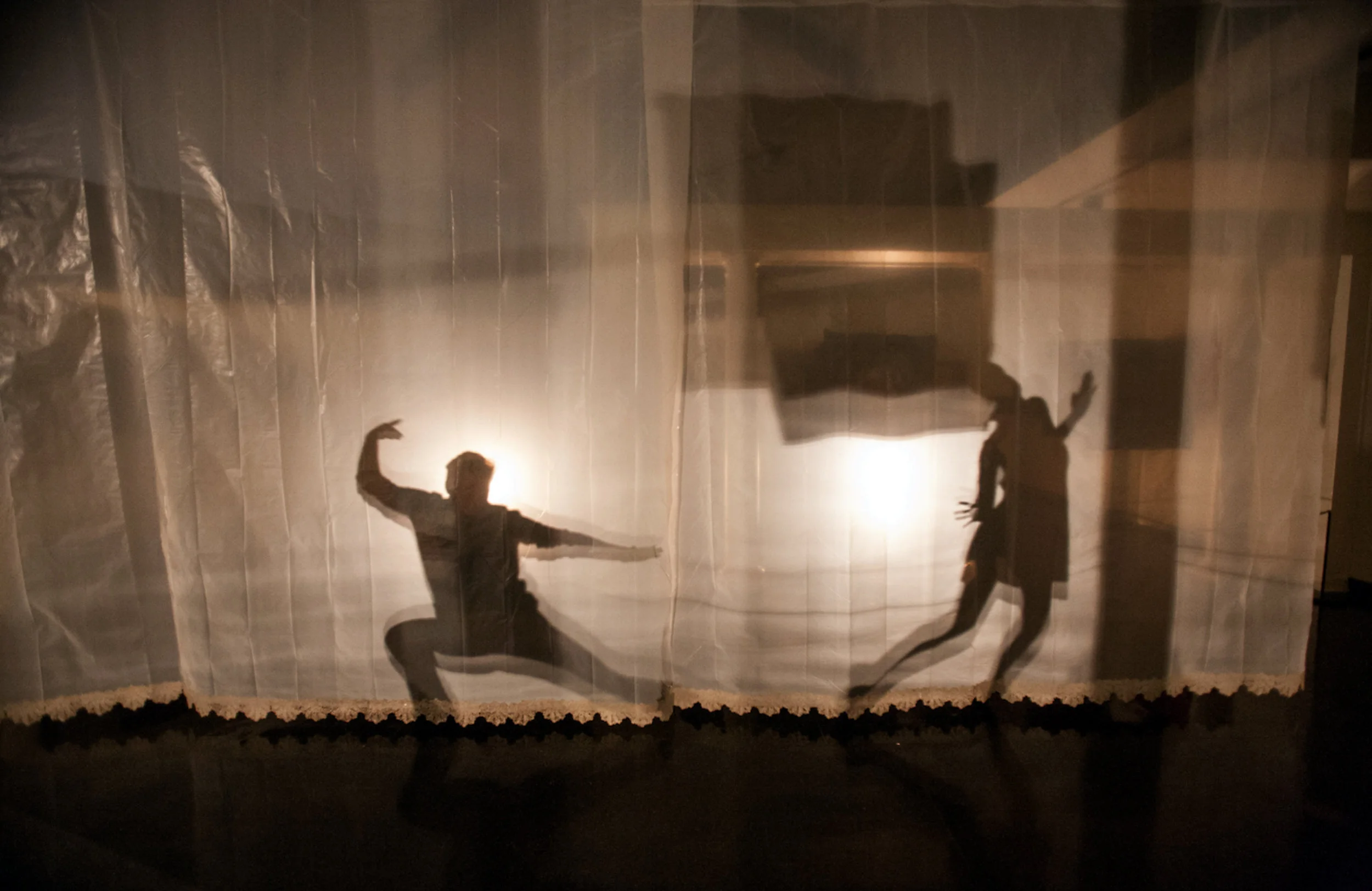
The audience is encouraged to move freely within a choreographed space and immerse themselves in the exhibit with permission to experience and interact with installations and performers. Pictured: Jade Primicias, dancer
Performers: Jade Primicias, dancer; Cast: Rachel Bravenic, Jacob Carr, Taylor Dent, Ellen Emerson, Emily Keith, Katie Knight, Paige McCord, Carrie Moscoe, Deanna Oglesby, Alex Reeves, Hadley Rouse, Patricia Valone, Troy Wethington, Abigail White, Sean Whittighill. Guitar: John Martin
Fuller Projects, Bloomington, Indiana
This project seeks to activate positive social change via a pop-up community-curated museum created by individuals from their personal objects. The work exists in the intersecting space inhabited by social practice, community organizing, and current developments in 21st Century museology.
Using a DIY methodology adopted from physical and organizational tools of grass-roots organizing, the project is intended to be easily replicable for use in interested communities.
Produced by Kristina Arnold with the assistance of community curators.
Public call for participants to bring objects for exhibition in the Pop-Up Museum of Social Change.
April 2017, Bloomington, Indiana
Community curators assist participants with categorizing and installing their objects.
Object processing and documentation
Marilee Salvator and Kristina Arnold were introduced to each others’ practices when they became colleagues at WKU in 2015, discovering that their work shares both a similar set of biologically-based inspirations and a compatible visual aesthetic: collaborative experiments seemed like a logical next step. Working multiple pieces at a time, the artists trade off, layering down marks via press, screen, hand and sewing machine. They work back and forth, making editorial decisions together along the way.
Layers and marks simultaneously create both addition and subtraction. Through a process of continual accretion, elements combine, imagery emerges, is removed, and eventually stabilizes. With references to botanical and human biology, the duality of growth as both generative and destructive is explored. Working together, the artists have created an energetic, new series that that encapsulates a combined aesthetic and contains recognizable elements from each artist.
To see Marilee Salvator's work, visit: http://marileedsalvator.com/
etching, screen-printing, archival pigment printing, woodcut, ink, stitching, 32.5" x 22"
screen-printing, archival pigment printing, ink, stitching, 21.5" x 29.5"
etching, screen-printing, cyanotype, stitching, ink, 30" x 23"
etching, screen-printing, cyanotype, stitching, ink, rhinestones, 27" x 32"
screen-printing, lithography, 29.5" x 22"